Stratified alveolar gland
Sebaceous gland · H&E
Labelled structures
This image has no labels – use the caption instead.
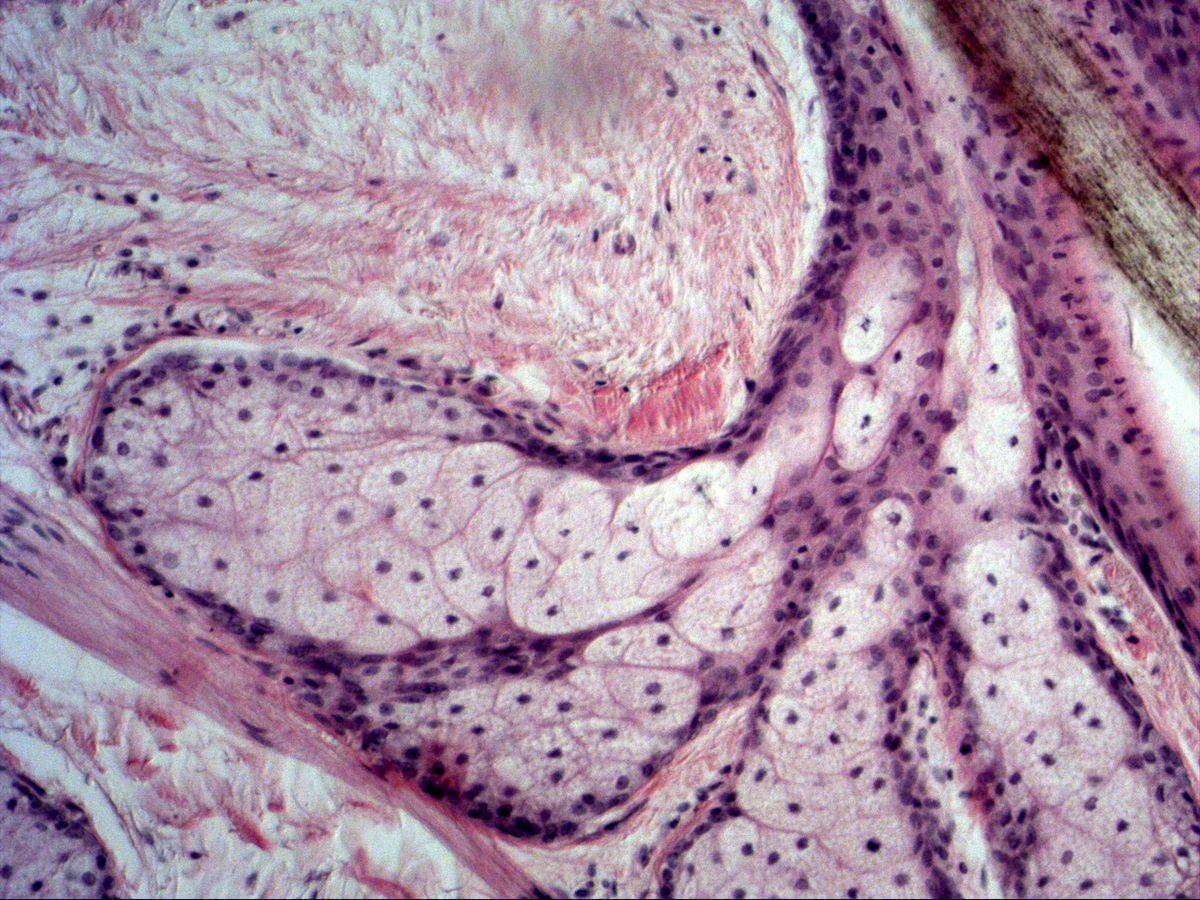
The stratified alveolar gland is found in the dermis, where sebum is produced by holocrine secretion. In holocrine secretion the gland cells perish together with their contents. This can be recognised by the nuclei becoming pyknotic.
Sebaceous glands (glandulae sebaceae) almost always belong to a hair follicle and form the pilosebaceous unit with it. Their berry-shaped secretory portions (sebaceous alveoli) do not consist of a single cell layer but are filled with cells that mature from the periphery inwards, fill with lipid and finally become the secretion as a whole.
How to recognise it
- Large, pale, foamy cells in grape-like alveoli
- Dark basal cell layer at the edge of the alveolus
- Small, dark, pyknotic nuclei in the centre
- No true lumen in the secretory portion
- Located in the dermis next to a hair follicle
Structures to find
- Sebaceous alveolus (alveolar end piece)
- Lipid-filled glandular cells (sebocytes)
- Basal cell layer
- Basement membrane
- Pyknotic nuclei
- Secretion (sebum)
- Hair follicle
Structure
Each sebaceous alveolus is surrounded by a basement membrane and delicate connective tissue. On the outside lies a single row of small, dark, cuboidal basal cells – the stem cell layer of the gland. Towards the centre the cells (sebocytes) become progressively larger; their cytoplasm fills with lipid droplets and appears pale and foamy after paraffin embedding. In the centre the nuclei shrink, become small and dark (pyknotic) and dissolve. The sebum reaches the hair canal via a short duct lined by stratified squamous epithelium. Several alveoli may open into one duct.
Function
In holocrine secretion the entire cell together with its contents becomes the secretion. Sebum consists of triglycerides, wax esters, squalene and cell debris. It greases hair and the horny layer, keeps the skin supple and water-repellent and has a mild antimicrobial effect through free fatty acids. The lost cells are continuously replaced from the basal cell layer. Sebum production is controlled hormonally, mainly by androgens – not by nerves.
For comparison: apocrine glands (e.g. scent glands, the lactating mammary gland) pinch off apical portions of cytoplasm, while eccrine (merocrine) sweat glands release their secretion by exocytosis; both have a single-layered epithelium around a wide lumen.
Microscopy tips
In the dermis next to a hair follicle (often with a pigmented hair shaft), look for large, pale, grape-like cell clusters. The gradient from outside to inside is typical: a dark rim of basal cells, then large pale cells with a central nucleus, and small, dark, pyknotic nuclei in the centre. The secretory portion has no true lumen. Avoid confusing it with adipose tissue: adipocytes are unilocular with a flattened peripheral nucleus, whereas sebocytes are multivacuolar and foamy with a central nucleus. Sweat glands, by contrast, are small coiled tubes with a lumen.
Clinical relevance
In acne vulgaris, androgen-driven increased sebum production and abnormal keratinisation in the hair canal lead to comedones; bacteria (Cutibacterium acnes) promote inflammation. Isotretinoin works by markedly shrinking the sebaceous glands. Free sebaceous glands without hair occur, for example, at the vermilion of the lip, in the eyelid (meibomian glands) and on the areola; blockage of the meibomian glands causes a chalazion. Common in older age is harmless sebaceous hyperplasia, with small yellowish papules on the face.
Slide images
Test your knowledge
Assign the correct number in the image to each term.
Tap the requested structure in the image.
Multiple-choice questions on structure and function.
Frequently asked questions
What does 'pyknotic' mean?
Pyknosis is the condensation and shrinkage of the nucleus during cell death; the nucleus becomes small, round and very dark. In the sebaceous gland it marks the transition of the cell into secretion.
Why do sebocytes look pale in the section?
The lipid droplets are dissolved out by alcohol and xylene during paraffin embedding. What remains is a fine, honeycomb-like cytoplasmic framework.
Why is the sebaceous gland called 'stratified'?
Because the secretory portion is not formed by a single cell layer around a lumen but is completely filled with several layers of maturing cells.
Related topics
Updated: